
Residents of Zehri tehsil in Khuzdar district have accused the Pakistani military of carrying out indiscriminate air and drone strikes that have killed civilians, including women and children, amid a siege that has continued for over a month.

'India for its survival has to change its doctrine from no first use to a pre-emptive attack in case of any hostile move by Pakistan,' recommends Colonel Anil A Athale (retd).

Chief of Air Staff Air Chief Marshal A P Singh on Thursday flagged serious concerns over inordinate delays in various defence acquisition projects and failure to stick to delivery schedules for supply of key platforms even as he hailed Operation Sindoor as a 'national victory'.

The Indian Air Force conducted precision strikes on terror hideouts in Pakistan, targeting a Jaish-e-Mohammad communication network housed in a primary health centre in Tehra Kalan village. The communication setup was essential for planning and coordinating activities with infiltrated terrorists in Jammu and Kashmir. The strikes aim to dismantle the communication network and hinder the terrorists' ability to operate.
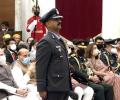
Major Syed Moiz Abbas Shah, 37, was killed on Tuesday in a clash with the Taliban militants in the Sararogha area of South Waziristan near the Afghan border, according to a statement by the Inter-Services Public Relations (ISPR), the media wing of the army.
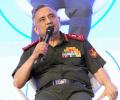
Chief of Defence Staff General Anil Chauhan on Saturday acknowledged losses of aircraft in India's recent military hostilities with Pakistan but dismissed as 'absolutely incorrect' Islamabad's claim of downing six Indian fighter jets.

The ministry of external affairs also seemed to reject Trump's forceful comments that Washington brokered the understanding between India and Pakistan on ending their four-day military conflict.
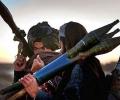
Five Pakistani soldiers and at least 27 militants, including some foreigners, were killed On Sunday in clashes and air strikes in the restive northwestern tribal belt, where the military has launched a major offensive against the Taliban.
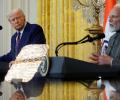
US President Donald Trump said on Friday that there has always been tension between India and Pakistan and the two countries will figure it out between themselves. Trump was asked about tensions between India and Pakistan in the wake of the Pahalgam terror attack, in which 26 civilians were killed, and if he would be talking to the leaders of the two nations. He said that he knows both leaders and that there is great tension between Pakistan and India, but there always has been.
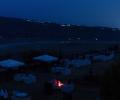
Meanwhile, a precautionary blackout has been enforfced in the multiple areas amid the esclating tensions between India and Pakistan.

Stressing that wars are "very bad", Trump said that he seems to have "an ability to end them, to get people together" for which he uses the "power of the United States".

They weren't up for a windfall even after the trophy but life was certain to get a lot better as some sponsors and state governments stepped up to lift them financially.
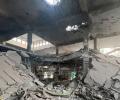
Pakistan claims it was a mosque and an educational complex that were hit in the strikes at Muridke, located at about 40 km from Lahore.
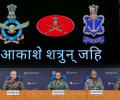
The Indian Air Force on Monday said all its military bases and systems continue to remain fully operational, and ready to undertake any further missions if the need arises.

Indian Oil Corporation (IOC), the nation's largest oil firm, on Friday said ample stocks of petrol, diesel and cooking gas LPG are available in the country and there is no need for panic buying of fuel. The statement comes after social media was flooded with posts and videos showing people queuing at petrol pumps to stock fuel as tensions between India and Pakistan escalated.

The CII Business Summit 2025's inaugural session witnessed a rousing standing ovation and a felicitation ceremony for the defence top brass sending a strong message about India's rising military industrial complex and hghlghting that security is a top-of-the-mind issue for India Inc.
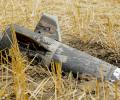
Debris resembling parts of a missile was found in a field in Hoshiarpur, Punjab, while metal parts of unidentified objects were discovered at two locations in Bathinda, sparking panic among locals. The incidents come after India successfully thwarted Pakistan's attempts to target military installations with drones and missiles across the country.
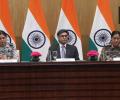
Colonel Sofiya Qureshi revealed that 300 to 400 drones were deployed across 36 locations, with several being shot down by Indian forces using both kinetic and non-kinetic methods.

Up until recently, she was flying the MiG-21s and was recently posted to the LCA squadron deployed in Naliya air base in the Gujarat sector along the border with Pakistan.
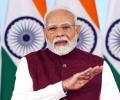
Presenting the full text of Prime Minister Narendra Modi's address to the nation on May 12, 2025, in which he dictated India's new doctrines on countering terrorism.

PBKS-DC game also uncertain, say BCCI Sources

The BJP on Saturday accused the Congress of repeatedly supplying "oxygen" to Pakistan, and slammed the opposition party for its leader Charanjit Singh Channi's remarks questioning the veracity of Balakot air strikes after the 2019 Pulwama terror attack. BJP national spokesperson Sambit Patra alleged that the Congress is full of pro-Pakistan leaders who make statements against India's interests, and mocked the party for its letter that had advised its functionaries to toe the official line on the issue. Patra also criticized other Congress leaders for their comments on the Pulwama and Pahalgam terror attacks, accusing them of lowering the morale of the armed forces. He further slammed the Congress for claiming credit for the government's announcement of the caste census and said the party never carried out the exercise during its over 60-year stint in power.
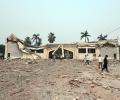
A total of nine terror sites in Pakistan, including five in Pojk, linked to Lashkar-e-Taiba (Let) and Jaish-e-Mohammed (Jem), were targeted with meticulous planning to avoid civilian casualties.
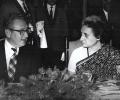
'She was brave. She didn't care a hoot. And India was not the strongest of nations as it is now.'
'She was brave. She didn't care a hoot. And India was not the strongest of nations as it is now.'
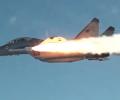
'For weeks, months and years, it would continue to be debated if India should have pushed the early advantage and decapacitated Pakistan militarily.' 'India refused to bite the provocatively proverbial bullet and escalate it into a full-fledged war,' notes N Sathiya Moorthy.

'As far as I'm concerned, how effective the Rafale was or frankly, how effective other systems were -- to me, the proof of the pudding is the destroyed and disabled airfields on the Pakistani side'
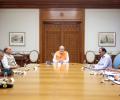
'The government has to explain (to the army, air force and navy chiefs) whether they want a punitive strike, a deep punitive strike, or whether they want limited war or an all-out war, will it be a circumscribed war or will it be a shallow attack along the border.'
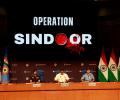
Reliance Industries Ltd has withdrawn its trademark application for the term 'Operation Sindoor' -- the codename for India's military strikes in Pakistan -- stating that it was inadvertently filed by a junior employee without authorisation.

The Indian military also acknowledged suffering some losses but declined to provide the details as the operations are going on.

India has strongly condemned Pakistan's recent drone attacks on Indian cities and civilian infrastructure, calling it a "deranged fantasy" and a desperate attempt to deceive the world. Foreign Secretary Vikram Misri also accused Pakistan of attacking religious sites, including a gurdwara in Amritsar, in an attempt to give a communal color to the situation. Misri criticized Pakistan's "blatantly farcical denial" of the attacks and said the country is resorting to disinformation tactics.

The Director Generals of Military Operations (DGMOs) of India and Pakistan on Monday deliberated on various aspects of the May 10 understanding reached between the two sides on cessation of hostilities.
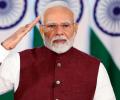
Operation Sindoor has carved out a new benchmark in our fight against terrorism, and has set up a new parameter and new normal. Operation Sindoor is not just a name but a reflection of the emotions of millions of Indians. Operation Sindoor is an unwavering pledge for justice. Terrorists dared to wipe 'sindoor' from the foreheads of our sisters; that is why India destroyed the very headquarters of terror.
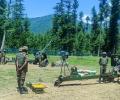
'The precision strikes were well planned and excellently executed. The world will be studying this operation.'

IAF Chief Dhanoa and Abhinandan took a sortie on the MiG 21 jet from the Pathankot air base.

Sources added that Commanding Officer of Pakistan's 7 Northern Light Infantry inspected the site along with other officials.
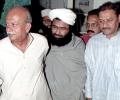
The Pakistan army's Bahawalpur Corps has always had a special significance for India as it keeps an eye on the Jaish e Mohammed, explains Rana Banerji, who headed the Pakistan desk at RA&W.

Rain forces abandonment of India's match against Bangladesh; Rawal injury scare for hosts
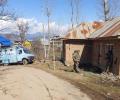
Security agencies are concerned about the increasing use of drones by terror groups in Jammu and Kashmir for surveillance and logistics, replacing human networks.

The American government is providing the used aircraft free of cost to Pakistan, which will only have to bear the shipment costs. The delivery of the aircraft was authorised by the US administration on Wednesday.
